 中文
中文
 English

CPO and LPO
Author:Dongguan Feifu Technology Co., Ltd
Click:
Time:2025-12-06 17:03:12
With the rapid advancement of optical communication technology, data centers are increasingly demanding high-speed, efficient, and low-energy optical interconnection solutions. CPO (Co-Optical Packaging) and LPO (Linearly Driven Pluggable Optical Module), two prominent technologies, each demonstrate unique advantages in optical module applications. However, CPO offers distinct benefits over LPO in multiple aspects.
I. Technical Principles and Integration Advantages
(1) Highly integrated architecture
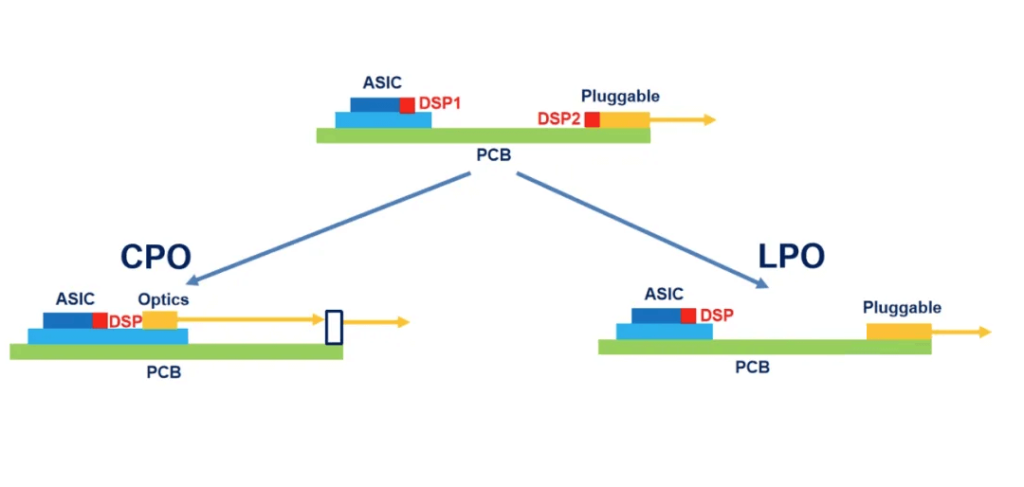
CPO technology integrates network switching chips and optical modules into a single slot, achieving seamless integration between optical engines and switching chips. This highly integrated architecture significantly reduces the distance between switching chips and optical engines, fundamentally optimizing electrical signal transmission paths. Taking the typical connection between data center switches and optical modules as an example, traditional methods would cause signal attenuation and delay over long transmission lines. CPO technology dramatically shortens signal transmission distances, effectively enhancing electrical signal transmission speed, ensuring signal integrity, and reducing the likelihood of signal distortion and interference.
In contrast, LPO (Linear Passive Optical) employs linear direct-drive technology to eliminate DSP/CDR chips in optical modules, integrating these functions into the switching chip on the device side. However, the optical module and switching chip remain relatively independent, and the integration and optimization of signal transmission are far inferior to those in CPO (Cable Passive Optical).
(2) Efficiency of Collaborative Work
CPO technology enables deep integration between network switching chips and optical modules. Their physical proximity facilitates highly efficient data processing and transmission. For instance, during high-volume data processing, the switching chip promptly and accurately delivers data to the optical module for signal conversion and transmission, while the optical module swiftly responds by converting received optical signals into electrical signals for feedback. This optimized collaboration significantly enhances CPO's performance in handling massive data volumes and high-speed transmission tasks, thereby boosting the overall efficiency of optical communication systems.

In contrast, the LPO's optical modules and switching chips rely on external interfaces and communication protocols for coordination, which limits their data interaction in terms of timeliness and efficiency, making it difficult to meet the stringent demands of future ultra-high-speed, large-scale data transmission.
II. Performance Advantages
(1) Low power consumption characteristics
As energy consumption becomes a pressing concern in data centers, power efficiency has emerged as a key metric for evaluating optical communication technologies. CPO technology significantly reduces energy loss during signal transmission by shortening transmission distances and optimizing integrated architectures. Research data indicates that under identical data transmission rates, CPO-based optical communication systems can achieve 30% to 50% lower power consumption compared to traditional solutions. For large-scale data centers, this translates to substantial annual savings in electricity costs while supporting their green energy-saving objectives.
While LPO reduces power consumption by eliminating DSP chips, its discrete optical module and switching chip design still makes it less efficient than CPO in overall power management. This power disadvantage becomes particularly pronounced in long-distance, high-speed data transmission scenarios.

(2) High Transmission Rate and Stability
With its unique architecture and collaborative mechanisms, CPO technology enables higher transmission rates. Currently, it supports high-speed data transfers of 800Gbps and even 1.6Tbps, demonstrating exceptional stability. In complex network environments, CPO effectively resists external interference, ensuring accurate and continuous data transmission while reducing bit error rates. For instance, in AI data centers where massive training datasets require high-speed, stable transfers, CPO technology perfectly meets these demands, ensuring efficient AI model training.
The LPO design, which eliminates the DSP chip, increases the system bit error rate, creating limitations in transmission distance and speed. It is therefore better suited for short-range applications with lower speed requirements. However, in long-distance ultra-high-speed data transmission, the LPO's stability falls short compared to the CPO.
III. Cost and Maintenance Advantages
(1) Long-term cost advantage
In the long run, CPO technology demonstrates significant cost advantages. While the initial R&D and deployment phases entail relatively high costs, these expenses will gradually decrease as the technology matures and achieves mass production. The highly integrated design of CPO reduces the number of interfaces between optical modules and switching chips, as well as external cable connections, thereby lowering hardware and cabling costs. Additionally, CPO's low-power characteristics enable substantial savings in electricity costs during extended operation.
While LPO reduces optical module procurement costs and eliminates DSP chip material expenses, its long-term cost advantage remains limited due to higher performance requirements for equipment-side switching chips and additional wiring costs.
(2) Convenience and Reliability of Maintenance
In terms of maintenance, CPO technology demonstrates exceptional reliability. Its high integration reduces external connection points and potential failure points, thereby lowering the probability of malfunctions. When issues do occur, CPO technology can swiftly pinpoint problems through advanced monitoring and diagnostic capabilities, significantly improving maintenance efficiency. For instance, after implementing CPO technology in a large data center, equipment failure rates decreased by 30%, while maintenance time was cut by 50%.
Although LPO supports hot-swapping and is convenient for individual optical module maintenance, its relatively loose system architecture requires consideration of compatibility and coordination between optical modules and switching chips during overall system maintenance, resulting in higher maintenance difficulty and complexity.
IV. Current Development Status, Challenges, and Future Feasibility Comparison
(1) Current Status, Challenges and Future Feasibility of LPO Development
1. Current Development Status
Technically, LPO has made significant strides in the 800G optical module sector. For instance, at 800Gbps speeds, power consumption can be reduced to approximately 8W, representing a substantial 40-45% decrease compared to traditional plug-and-play optical modules. In market applications, several companies have begun deployment. At OFC2023, Arista was the first to present test results of 51.2T switches equipped with LPO transceivers. Nvidia is also expected to deploy 200G per-channel LPO transceivers in its AI clusters by 2025. Leading industry clients like Meta are actively considering adopting LPO technology.
2. Facing difficulties
LPO requires specific modules to work with ASIC switching chips, which diminishes the universal advantages of plug-and-play modules. Furthermore, challenges in link performance and responsibility allocation, coupled with complex testing procedures, have led to the absence of unified electrical and optical standards. This makes interoperability between modules from different suppliers difficult to ensure. Additionally, while removing DSP chips reduces power consumption and costs, it also increases system bit error rates, creating bottlenecks in improving transmission distance and speed.
3. Post-implementation feasibility
Despite challenges, LPO has emerged as a robust alternative to CPO in 100G per-channel interconnects. By 2029, LPO penetration is projected to reach 3% in 800G ports, 33% in 1.6T ports, and 15% in 3.2T ports. If NVIDIA implements LPO for NVLink expansion in its next-generation RuBing GPUs, it will significantly boost demand for 1.6T-DR8 LPO modules, potentially adding over 8 million 1.6T LPO ports by 2027. With continuous technological advancements and evolving industry standards, LPO remains a promising solution for short-range, cost-sensitive scenarios where speed requirements are not critical.
(2) Current Status, Challenges, and Future Feasibility of CPO Development
1. Current Development Status
Technically, CPO has achieved high-speed data transmission rates of 800Gbps or even 1.6Tbps, with outstanding power efficiency. Broadcom and Cisco's CPO products have achieved low power consumption of approximately 7pJ/bit, while solutions from IBM, Coherent, and other companies have further reduced power consumption to even lower levels. In terms of industry deployment, Broadcom announced its next-generation switching ASIC product line equipped with CPO as early as 2021, with its Bailly product line already in production. Cisco showcased a CPO prototype at OFC2023, while Intel integrated its Silicon Photonics Group under the Data Center and AI (DCAI) division to fully develop optical engines based on silicon photonics. Additionally, numerous companies including Ranovus, Marvell, Nubis Communications, Lightmatter, and IBM have joined the CPO technology R&D efforts.
2. Facing difficulties
From a technical standpoint, the wiring process of connecting optical fibers from ASICs to PCB front panels presents significant challenges, while post-integration testing and optimization remain complex. Reliability-wise, CPO technology integrates multiple optical modules with chips, leading to increased failure rates. For instance, Broadcom's CPO lab product integrates 16 optical modules on a single board, resulting in failure rates over tenfold higher and reliability stability reduced to one-tenth of the original. From a market perspective, CPO R&D requires substantial capital and manpower investment, with complex production processes. Cost reduction demands time and economies of scale, making it difficult to compete with optical modules in the short term. Moreover, major North American CSP cloud providers show limited interest in CPO, with some overseas companies even downsizing R&D teams. Additionally, mass production of CPO faces numerous technical challenges. Its standard is set at 3.2T per generation, with mass production expected at least until 2027 or later. Currently, Broadcom is making the fastest progress, with its first-generation CPO engineering trials scheduled for 2025.
3. Post-implementation feasibility
According to the '2025 China CPO Industry Market Development Trend and Industrial Demand Analysis Report' released by Beijing Zhiyan Kexin Consulting Co., Ltd., the commercialization of CPO technology is expected to start from 800G and 1.6T ports, with commercialization beginning in 2024 to 2025, followed by large-scale growth from 2026 to 2027. It is projected that by 2033, the global CPO market size will reach $2.6 billion. With continuous technological maturity, gradual cost reduction, and sustained market demand for high-speed, low-power optical communication solutions, CPO is poised to play a significant role in the future of optical communication, particularly in data center scenarios with extremely high requirements for transmission speed and power consumption. Market reports also indicate that NVIDIA may launch a new CPO switch at its GTC conference in March 2025. Supply chain sources reveal that this CPO switch is currently in trial production, and if progress is smooth, mass production could begin as early as August this year. These developments highlight the potential for future growth in CPO technology.
In conclusion, CPO technology demonstrates significant advantages over LPO in technical principles, performance, cost, and maintenance. Although both CPO and LPO currently face distinct challenges during their development (with CPO proving more commercially challenging than LPO), CPO is poised to dominate the optical communication industry in the long run. This is driven by its unique strengths, supported by continuous technological breakthroughs and a maturing market landscape, positioning it to lead the industry's evolution.
