 中文
中文
 English

2025 In-depth Analysis of the Optical Module Industry: Driving Factors, Current Status, Trends, and an In-depth Review of the Industry Chain and Related Companies
Author:Dongguan Feifu Technology Co., Ltd
Click:
Time:2025-10-30 21:41:54
I. Concept and Classification of Optical Modules
1. Concept of Optical Modules
An optical module is one of the core components of an optical communication system, composed of various passive components and optoelectronic chips assembled in a package. As the basic unit of data center interconnection (DCI), 5G bearer networks, and all-optical access networks, its primary function is to realize the optoelectronic conversion and electro-optical conversion in fiber-optic communications.
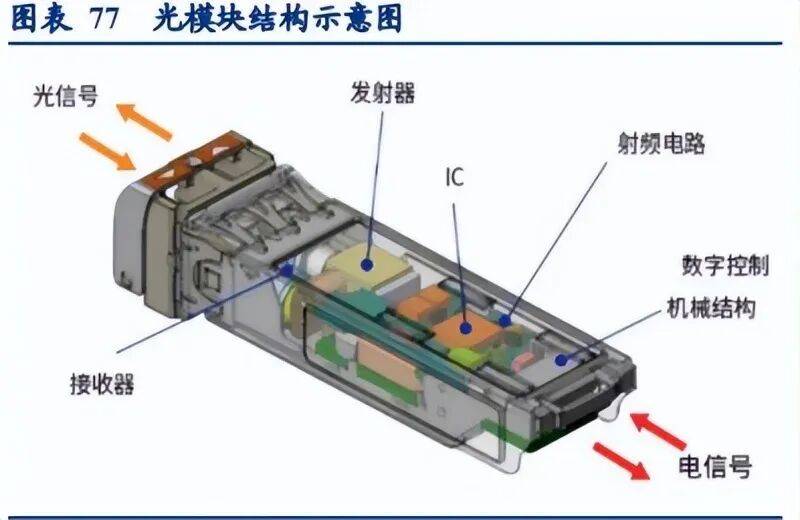
In terms of structure, an optical module mainly consists of a transmitter optical subassembly (TOSA, including a laser), a receiver optical subassembly (ROSA, including a photodetector), functional circuits, and optical (electrical) interfaces.
Its working principle is based on optoelectronic conversion:
- At the transmitting end, electrical signals are processed by a driver chip, which then drives a laser or light-emitting diode (LED) to emit modulated optical signals.
- At the receiving end, optical signals are converted into electrical signals by a photodetector, which are then amplified, processed, and output as corresponding data signals.
In addition, an optical module also includes components such as functional circuits, interface circuits, dust caps, heat sinks, labels, connectors, housings, receiving interfaces, and transmitting interfaces. All these components work together to ensure the efficient transmission and processing of optical signals.
2. Common Classifications and Applications of Optical Modules
Optical modules can be classified in various ways according to their characteristics and application scenarios.
- By package type: There are multiple types including SFP, SFP+, QSFP, XFP, CFP, and COBO.
- By transmission rate: Optical modules cover a wide range of rates such as low rate, 100 Mbps, 1 Gbps, 2.5 Gbps, 10 Gbps, 40 Gbps, and 100 Gbps.
With continuous technological progress and market changes, new types and specifications of optical modules are constantly emerging.
II. Driving Factors
1. Demand Engines: Data Centers, AI, and 5G
Demand from downstream application markets is the fundamental driving force for the development of the entire optical module industry. Currently, market demand is mainly driven by AI and hyperscale data centers, with 5G and the traditional telecom market serving as supplements.
(1) Core Driving Force: AI and Hyperscale Data Centers
The global artificial intelligence market continues to grow, driving the rapid increase in demand for AI servers. According to IDC data:
- The global AI server market size is expected to reach USD 125.1 billion in 2024, rise to USD 158.7 billion in 2025, and hit USD 222.7 billion in 2028. Among this, the share of generative AI servers will increase from 29.6% in 2025 to 37.7% in 2028.
- In the Chinese market, the AI computing power market size reached USD 19 billion in 2024, and is projected to reach USD 25.9 billion in 2025 (a year-on-year growth of 36.2%), and further expand to USD 55.2 billion in 2028.
The rise of large models and the significant expansion of generative AI applications have continuously boosted the market size of AI servers, which in turn drives the rapid growth of optical module demand.
Driven by the explosive demand for AI computing power, capital expenditures (CapEx) of cloud vendors in China and the United States have maintained sustained growth, which is expected to drive up the demand for AI servers.
- North American cloud giants: Amazon, Microsoft, and Google have shown massive investment scales and sustained growth momentum in CapEx. Their combined CapEx reached USD 180 billion in 2024 (a year-on-year increase of 59.18%), and is expected to hit USD 303 billion in 2025.
- Chinese cloud vendors: Alibaba, Tencent, and Baidu have also increased their CapEx in recent years. Their total CapEx reached RMB 136.2 billion in 2024 (a year-on-year increase of 46.59%), and is projected to reach RMB 267 billion in 2025.
The rapid growth in demand for AI servers has led to the continuous expansion of the global optical module market size. Massive data exchange (i.e., 'east-west traffic') is required between GPUs within AI training clusters, which puts extreme demands on network bandwidth and latency. Take NVIDIA's DGX H100 server cluster as an example: a single cabinet requires more than 500 high-speed optical modules to meet its interconnection bandwidth demand of up to 4.8 Tbps. Driven by the strong demand for Ethernet optical transceivers from AI cluster applications and the upgrade of dense wavelength division multiplexing (DWDM) networks by cloud service providers, the global optical module market size will continue to expand.
(2) Secondary Driving Force: 5G and Telecom Market
The telecom market is the birthplace of optical module applications. Since the advent of optical fibers in the 1980s, optical communication applications have evolved from backbone networks to metropolitan area networks, access networks, and base stations. At present, domestic transmission networks have basically completed fiberization.
From the perspective of telecom network transmission demand, the 5G transmission network consists of fronthaul, midhaul, and backhaul, which connect cellular base stations, core networks, and data centers respectively:
- Fronthaul mainly uses 10G and 25G optical modules.
- Midhaul mainly uses 50G, 100G, and 200G optical modules.
- Backhaul mainly uses 100G, 200G, and 400G optical modules.
The fronthaul subsystem is characterized by long distance and high density, and has the largest demand for optical modules compared with midhaul and backhaul.
In recent years, China has vigorously promoted the construction of gigabit fiber networks and 5G networks. According to data from the Ministry of Industry and Information Technology:
- By the end of 2024, the number of fixed broadband internet access ports reached 1.202 billion, a year-on-year increase of 66.12 million. Among them, fiber-to-the-home/office (FTTH/O) ports reached 1.16 billion, a year-on-year increase of 65.7 million; 10G PON ports with gigabit network service capabilities reached 28.2 million, a year-on-year increase of 5.183 million.
- By the end of 2024, the number of 5G base stations in China reached 4.251 million, a year-on-year increase of 874,000. 5G base stations accounted for 33.6% of the total number of mobile phone base stations, an increase of 4.5 percentage points compared with the end of 2023.
2. Policy Support for the Development of the Optical Module Industry
In recent years, China's optical module industry has received great attention from governments at all levels and key support from national industrial policies. The state has successively issued a number of policies to encourage the development and innovation of the optical module industry. Industrial policies such as the Guidelines for the Construction of National Data Infrastructure, the Notice on Consolidating the Upward Trend and Further Boosting Industrial Economy, and the Implementation Opinions on Improving Manufacturing Reliability have provided a clear and broad market prospect for the development of the optical module industry, and created a favorable production and operation environment for enterprises.
III. Current Status and Trends of the Optical Module Market
1. Rate Iteration and Future Trends of Optical Modules
Directly modulated optical modules and coherent optical modules are two different technical solutions in optical communication, with the main differences lying in modulation methods and application scenarios.
- Directly modulated optical modules: Modulate optical signals by directly changing the driving current of the laser. They feature simple structure and low cost, and are mainly used for short-distance transmission scenarios such as internal connections within data centers.
- Coherent optical modules: Adopt more complex technologies to encode digital information by modulating parameters such as the phase and amplitude of light waves. At the receiving end, coherent detection is performed between the local oscillator and the received signal, which can demodulate phase, amplitude, and polarization state information simultaneously. Initially used for backbone networks with transmission distances exceeding 1,000 km, this technology has gradually extended to metropolitan area network applications with distances ranging from 100 km to 1,000 km. Coherent optical modules have higher spectral efficiency and receiving sensitivity, and can support higher transmission rates.
In terms of application fields, directly modulated optical modules are mostly used in short-distance, low-cost scenarios. With cost reduction driven by scale effects, coherent optical modules have expanded to various new application scenarios such as 5G, big data, and cloud computing, becoming the focus of data centers and metropolitan area networks.
AI is driving the upgrading of optical modules, with single-channel rates gradually increasing. With the rapid development of AI technology, demand for computing power has grown rapidly, further driving the development of 1.6T optical modules. It is expected that 1.6T and even higher-rate optical modules will become the new technical trend for internal connections in data centers, to meet the future demand for GPUs with larger bandwidth and higher computing power. According to Coherent's forecast, 800G and 1.6T optical modules are expected to become mainstream market products in the next five years. At present, the process of mass commercialization of 1.6T optical modules is accelerating, and this trend puts forward higher requirements for optical chips. Various chips including 200G PAM4 EML and CW light sources will become optical chip solutions for 1.6T optical modules.
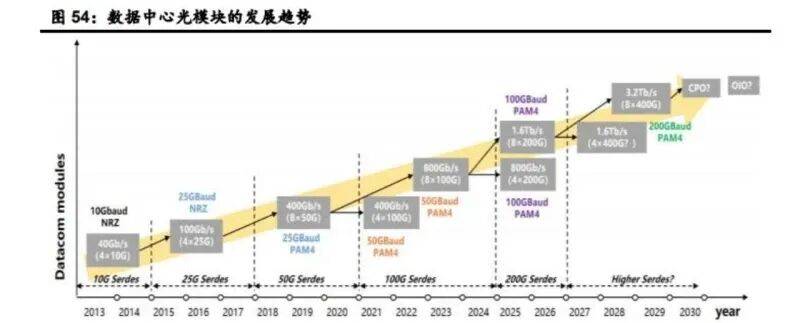
Data center traffic is experiencing rapid growth, and the interconnection rate in data center scenarios is developing faster than that in backbone networks.
- The iteration cycle of directly modulated and directly detected optical modules for data centers is about 3–4 years per generation, which has shown a shortening trend since the introduction of AI intelligent computing. The 400 Gbps rate is already widely used in data center interconnection (DCI), and the current mainstream rate is 800 Gbps. It is expected to enter the 1.6 Tbps rate in the next 1–2 years. By 2029, the rate of optical modules for AI applications will reach 3.2 Tbps, and 3.2 Tbps will move towards large-scale application in 2030.
- The iteration cycle of coherent optical modules for trunk networks is about 10 years per generation, with the current single-wavelength rate at 400 Gbps, which will reach 800 Gbps in 2030. Coherent technology is extending from trunk/metropolitan networks to medium-and short-distance applications within 100 km, and it is expected that the single-wavelength rate will reach T+ bps in 2030.
2. Forecast of Global and Domestic Optical Module Market Size
According to Lightcounting's forecast, the global optical module market size will grow at a CAGR of 22% from 2024 to 2029, and is expected to exceed USD 37 billion in 2029. In the Chinese market, the optical module market size reached approximately RMB 60.6 billion in 2024, and is projected to reach RMB 67 billion in 2025.
3. Forecast of Datacom and Telecom Optical Module Market Size
According to LightCounting's estimation:
- The global datacom optical module market size reached USD 6.25 billion in 2023, and is expected to grow at a CAGR of 27% from 2024 to 2029, reaching USD 25.8 billion in 2029. Among this, the Ethernet optical module market is expected to contribute the main growth, with a projected CAGR of 26% to reach USD 22.2 billion. The future growth driver of the datacom market mainly comes from the demand for high-speed optical modules. According to LightCounting's forecast, the market size of 800G Ethernet optical modules will surpass that of 400G in 2025; with the rapid introduction of high-speed optical modules, the overall market size of 800G and 1.6T optical modules is expected to exceed USD 16 billion in 2029.
- The global telecom optical module market size reached USD 5.22 billion in 2023, and is expected to grow at a CAGR of 14%, reaching USD 11.49 billion in 2029.
4. High Certainty of 1.6T Optical Module Mass Production, with Deployment Curve Similar to 800G
According to the LightCounting report, benefiting from the rapid development of the AI industry, the time required for high-rate optical modules to reach a shipment volume of 10 million units is getting shorter and shorter.
- 800G optical modules were put into application in 2023, with shipments reaching about 7.5 million units in 2024, and demand exceeding 10 million units in 2025.
- Referring to the deployment curve of 800G products, 1.6T optical modules will start mass production in 2025, and shipments are expected to exceed 10 million units in 2026.
IV. Analysis of the Optical Module Industry Chain
The upstream of the optical module industry chain includes optical components, optoelectronic chips, PCBs, etc. Among these, optical chips are the basic components for manufacturing optical components, and serve as the source of key raw materials required for optical module manufacturing. Optical components can be divided into active components and passive components according to whether they involve optoelectronic conversion.
The midstream is the optical module manufacturing link. Optical modules are packaged with optical components, electrical chips, printed circuit boards, structural parts, etc., and are responsible for realizing optoelectronic signal conversion in optical communication.
The direct downstream customers of the industry chain are optical communication equipment manufacturers and server manufacturers, such as Huawei, ZTE, FiberHome, Inspur, and Lenovo. The end customers are operators, cloud computing vendors, and enterprise network clients.
In terms of the cost structure of optical modules:
- Optical components account for 73% of the total cost, and PCBs account for about 5%.
- In the cost structure of optical components, the transmitter optical subassembly (TOSA, dominated by lasers) and the receiver optical subassembly (ROSA, dominated by photodetectors) account for 48% and 32% respectively. The transmitter optical subassembly (TOSA) accounts for 35% of the total cost of optical modules.
